What It Actually Takes to Reclaim Illinois Land From Invasive Species — And What Happens If You Stop Too Soon
Clearing Invasives With Machinery Is the Beginning. What You Do Next Determines Whether You Win or Lose.
When someone calls me to clear a property in central Illinois the conversation usually starts the same way.
They know something is wrong. They've watched their timber change over the years. What used to be open, accessible, functional ground has become something they can barely walk through. They're not always sure exactly what took over or when it happened. They just know the property doesn't look or function the way it used to — and they've reached the point where they're ready to do something about it.
When I get there and see it for myself the scale of the problem is usually worse than they described.
What Overgrown Actually Looks Like
There's a version of overgrown that most people picture — some brush, some thicker areas, maybe a few spots that need attention. That's not what I'm talking about.
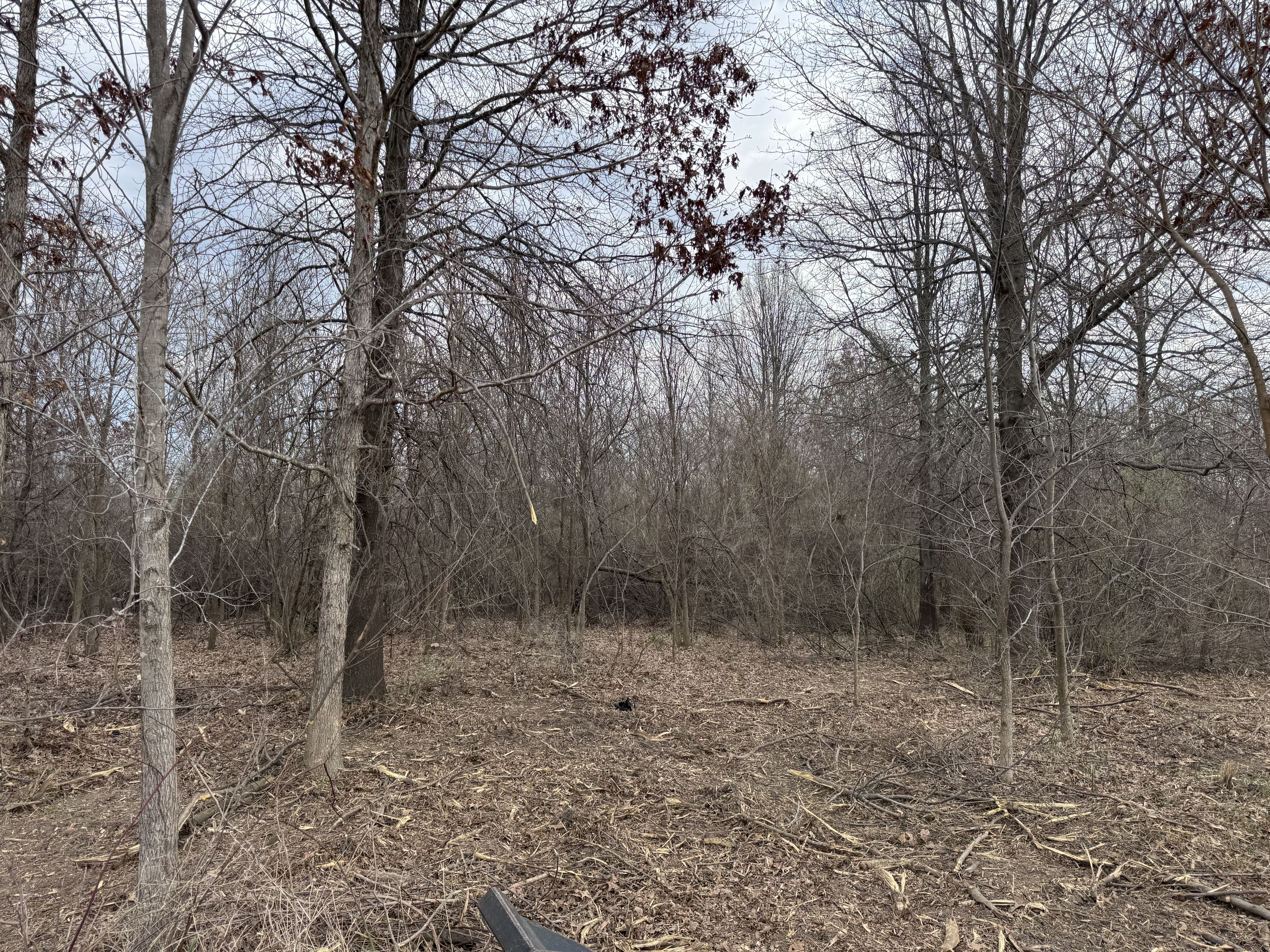
When autumn olive and honeysuckle have been running unchecked on a central Illinois property for years what you're looking at is a jungle. Not figuratively. A wall of invasive growth so dense you cannot see into it, cannot navigate through it, and in many cases cannot tell that there are intentional plantings underneath it. Properties where someone planted hardwood trees in deliberate rows decades ago — rows that were visible and accessible and productive — completely consumed by invasive growth to the point where you cannot identify the rows, cannot find the trees, and cannot tell that anything intentional was ever done with that ground.
That's what I pulled up to on a central Illinois legacy property recently.
Third generation family. The original owner converted tillable ground to a hardwood tree planting thirty years ago. His vision was wildlife habitat, timber value, and something that would improve with time and outlast him. The trees he planted were mature enough now to be significant. Walnut. Oak. Hardwoods with real timber value and real ecological function.
You couldn't see any of it.
Autumn olive had come in and taken over entire sections. Not small plants — growth large enough that you'd mistake it for established timber from a distance. Honeysuckle filling in everything underneath. Ground level completely barren in the dense sections because nothing gets light. No native understory, no regeneration, nothing. Just invasive canopy from the ground up and bare dirt beneath it.
The trees the original owner planted were in there somewhere. Some of them were still alive — barely. Walnut trees getting choked, their crowns compressed, their growth suppressed for years by the invasive competition surrounding them. Left alone another few seasons some of them wouldn't have made it.
This is what doing nothing actually looks like on an Illinois property over time.
What the Machine Does — And What It Doesn't
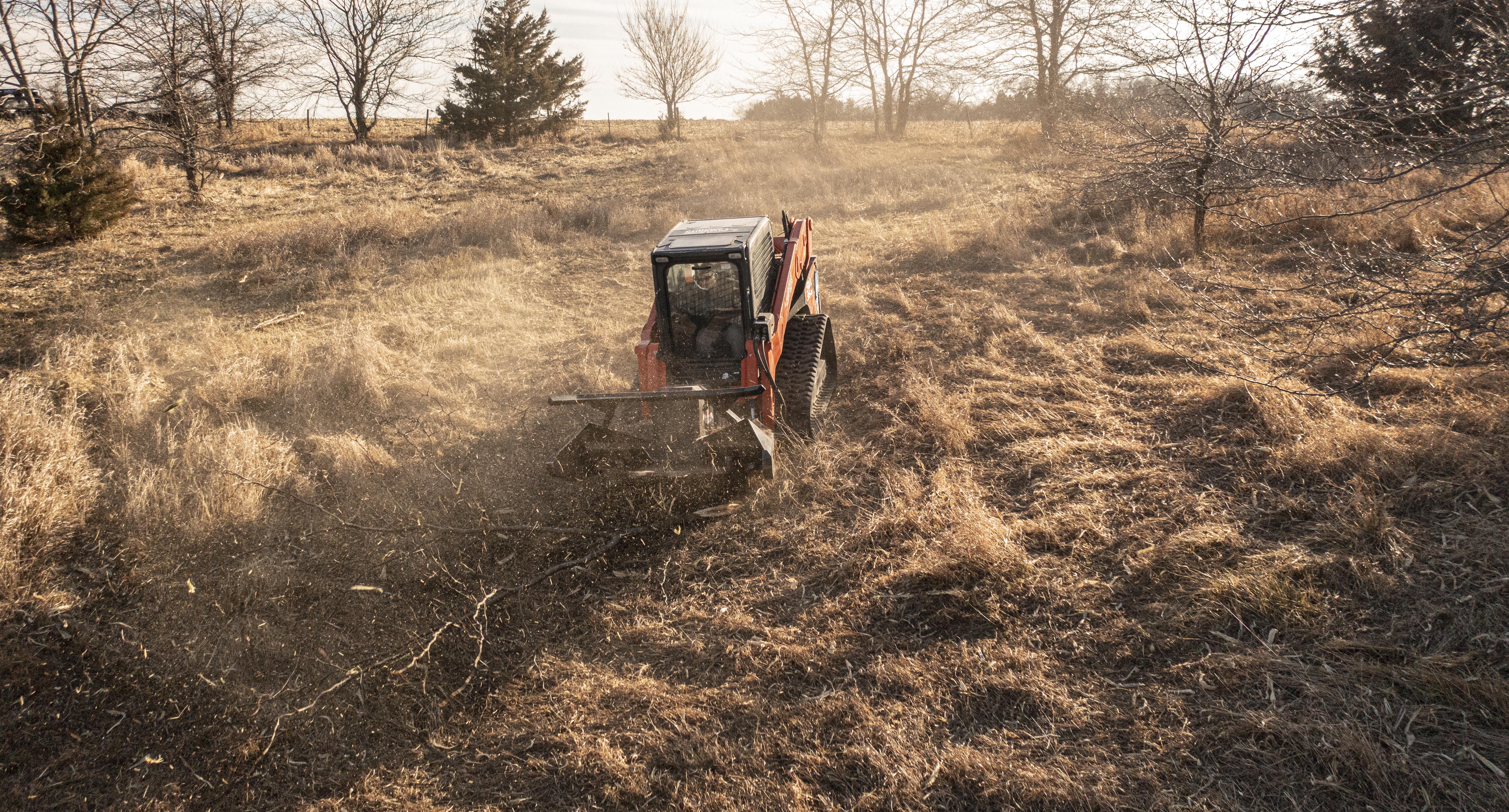
I run a Kubota with a Vail disc mulcher. When the scale of an invasive problem reaches the level I just described there is no realistic alternative to mechanical removal. Hand pulling is the right answer for young plants — and I've said that clearly in earlier content in this series. But when autumn olive is larger than a dump truck and honeysuckle has consumed entire sections of a thirty year hardwood planting, a backpack sprayer is not the tool for the job.
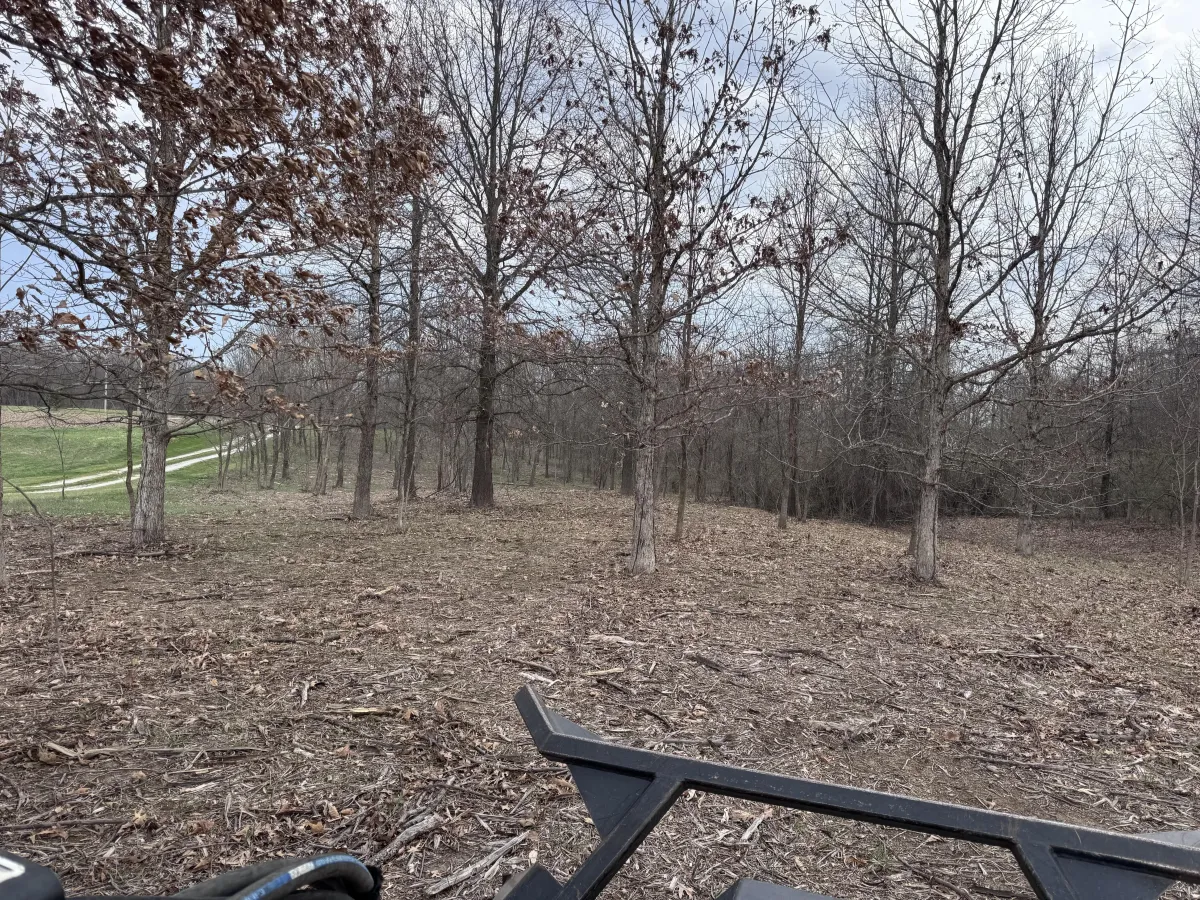
The mulcher processes everything in its path — invasive shrubs, brush, overgrowth — and returns it to the ground as mulch. What it leaves behind is open ground, standing timber that can finally breathe, and a property that is suddenly recognizable again.
The transformation is significant. Rows that hadn't been visible in years come back into view. The canopy structure of the hardwood planting — what the original owner actually built — emerges from underneath the invasive growth. Light reaches the forest floor for the first time in years. The property goes from something that functions as nothing more than dense cover to something that has structure, visibility, and potential again.
That moment — when you peel back the layers and the original intention of the property comes back into view — is one of the more satisfying things about this work. You're not just clearing brush. You're recovering something that took decades to build and was being systematically erased.
But here's the part most people don't talk about.
Why Clearing Is Only Half the Battle
Mechanical removal is the fastest, most dramatic intervention available for a property that has reached this stage. It works. The results are immediate and visible. A property that looked like a jungle in the morning looks like recoverable timber by afternoon.
And then nature starts fighting back.
This is the part of the conversation that doesn't get covered in most land management content — and it's the most important part for any Illinois landowner to understand before they bring in equipment.
When you remove invasive growth with a machine you do two things simultaneously. You eliminate the existing problem. And you create ideal conditions for the next wave.
Cleared ground with disturbed soil and suddenly abundant sunlight is exactly the environment invasive species are built to exploit. Honeysuckle seeds already in the soil germinate. Autumn olive root systems that survived the clearing send up new shoots. Species that were being suppressed by the previous canopy now have the light and space they've been waiting for. If you do nothing after mechanical removal — no burning, no follow-up spraying, no seeding with competitive native species — the property will be overtaken again. In some cases faster than before because the disturbance created better conditions for invasive establishment than existed before you started.
I've worked on CRP-type properties in central Illinois where the landowner brought me in to clear, saw the immediate result, and stopped there. No follow-up management. No burning. No chemical treatment of regrowth. No native seeding.
I've been back to some of those properties. They look worse now than before I cleared them.
That's not a failure of the clearing process. It's a failure of follow-through. The machine does its job. What happens next is the landowner's responsibility — and it requires a plan before the first tree comes down, not after.
What Follow-Up Management Actually Looks Like
The properties where mechanical removal works long-term are the ones where the clearing is treated as the first step of a multi-season management plan rather than the solution itself.
The window immediately after clearing is critical. Regrowth from surviving root systems will appear within weeks. That regrowth — young, small, accessible — is exactly the stage where foliar chemical treatment is most effective. The plant is small enough for the herbicide to reach the root system before it re-establishes. Treating regrowth in the first season after mechanical removal is significantly more effective than waiting until the second or third year when root systems have strengthened again.
Prescribed fire where appropriate suppresses non-fire tolerant invasive species and encourages native plant regeneration in the cleared areas. A single controlled burn in the right conditions can do more for long-term invasive management than multiple chemical treatments on established plants.
Native seeding into cleared areas creates competition that slows invasive reestablishment. Native grasses, forbs, and ground cover establish a plant community that competes with invasive species for light and resources. The property that gets seeded after clearing recovers its native character over time. The property that doesn't gets invaded again.
This is what long-term land management actually requires. Not a one-time intervention. A commitment to the ground that mirrors the commitment the original owner of this Cass County property made when he converted tillable acres to hardwood timber thirty years ago.
What This Means for Illinois Landowners
If you own timber in central Illinois — recreational ground, a farm with wooded areas, a legacy property that has been in your family for generations — the question isn't whether invasive species are present. In this region they almost certainly are. The question is what stage they're at and whether you have a plan that goes beyond the first intervention.
Catching it early means hand pulling and targeted foliar treatment. Missing that window means machinery. Bringing in machinery without a follow-up plan means starting over in three years.
The properties that hold their value, function well, and reflect the intention of the people who built them are the ones where someone is paying attention over time. Not just reacting when the problem becomes impossible to ignore.
That's what land management actually is. Not a single decision — a series of them, made at the right time, with the right tools, and with the long-term health of the property as the standard.
This Series Continues
This is the second article in an ongoing land management series built from real work on real properties across central Illinois. The first article covered early identification — what the first green in your timber actually means and why the identification window matters. Upcoming content covers property entrance and first impression, and long-term estate stewardship decisions on generational land.
If you own land in Illinois and want to understand what your property is doing over time — follow along.

Jared Williams is the Managing Broker of Archer Realty, a land and rural property brokerage serving central and greater Illinois. He is a landowner, farmer, licensed auctioneer, and land manager who works on properties across central and western Illinois including Cass, Menard, Sangamon, Macoupin, Greene, Morgan, and Fulton counties. Archer Realty specializes in agricultural, recreational, commercial, residential, and estate real estate throughout Illinois.
View current land listings or request a property evaluation at archerrealty.net.


