Why Macomb Commercial Property Is Selling for Less Than Replacement Cost — and Who Should Be Buying It
The Market Condition Most Buyers Miss
In commercial real estate, replacement cost is a foundational valuation concept: what would it cost to build this building from scratch today on a comparable site? When a property is trading below replacement cost, it means the market is pricing the existing asset at less than the cost to replicate it. That condition does not exist everywhere. In Macomb, Illinois, it exists right now.
New commercial construction in Illinois in 2026 is running $175 to $250 per square foot for basic to mid-grade commercial buildout — and that is before land acquisition, site work, permitting delays, and the carrying cost during a construction timeline that rarely moves as fast as projected. A 4,000-square-foot commercial building costs $700,000 to $1,000,000 to build new in central Illinois at current construction pricing.
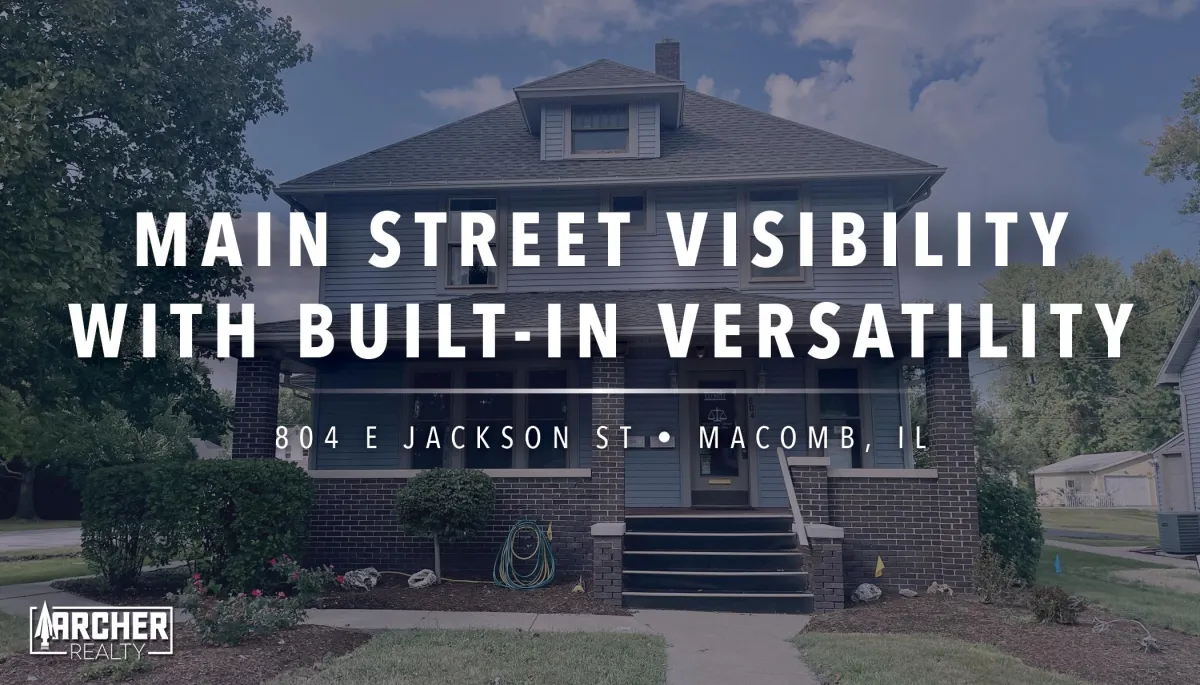
The 804/810 East Jackson Street property in Macomb — a commercial offering currently available through Archer Realty — represents approximately 7,200 square feet of existing commercial space on a high-visibility corridor in McDonough County. When you divide the acquisition price against the square footage and compare it to the cost of building new, the arithmetic is not close. Buyers are acquiring finished, occupied-ready commercial space at a fraction of what it would cost to develop it.
Why Macomb — and Why It Is a Different Lens
Macomb is the county seat of McDonough County in western Illinois. Western Illinois University anchors the local economy with enrollment, employment, and the healthcare, retail, and service demand that follows. The commercial market in Macomb does not behave like a Chicago suburb or a growing downstate city. Transaction volume is lower, the buyer pool is more local, and institutional capital largely ignores markets of this size.
That last point is where the opportunity sits. When institutional investors exit or avoid a market, they leave behind real assets at pricing that reflects their absence rather than the intrinsic value of the asset to a local user. An investor underwriting Macomb commercial property against a cap rate expectation driven by a Chicago or Champaign comparison is going to pass. A business owner who currently writes a $3,000 per month rent check and understands what ownership of that space would mean for their operating costs over a ten-year horizon is looking at the same property through an entirely different lens.
The Owner-Operator Math
The owner-operator calculation is simpler than investors make it. A business currently paying $3,000 per month in rent — $36,000 annually — is generating zero equity and building zero asset value through that expenditure. The payment disappears. The business has nothing to show for it at the end of the lease term except the option to negotiate another lease on terms the landlord controls.
An owner-operator who purchases a comparable property with seller financing at a purchase price of $350,000, structured at 7 percent over 15 years with a reasonable down payment, is looking at monthly debt service in the $2,800 to $3,100 range. At the end of 15 years, the building is owned free and clear. The business has an asset. The owner has equity. The economics of continuing to rent — at increasing rates, on terms not controlled by the business — versus owning at a comparable or lower monthly number is a calculation that resolves clearly for many operator situations.
When Seller Financing Changes the Equation
Conventional commercial lending in small Illinois markets has friction that deals in larger markets do not face. Appraisals are harder to support when comparable sales are thin. Lenders unfamiliar with western Illinois markets apply additional scrutiny. Loan-to-value requirements can force down payments that strain business liquidity.
Seller financing removes much of that friction. A motivated seller with clear title and no institutional debt on the property can structure terms directly with a qualified buyer — down payment, interest rate, amortization schedule, and balloon terms negotiated between the parties rather than dictated by a lender's underwriting guidelines. For the right deal and the right seller, this is not a concession — it is a feature that makes a transaction happen that otherwise would not.
The 804/810 East Jackson Street property in Macomb is a candidate for exactly this kind of structure. A buyer who understands the market, has a use for the space, and can demonstrate debt service capacity is positioned to have a direct conversation about terms. That conversation does not start with a bank — it starts with a clear-eyed look at the numbers and a seller willing to be the financing source.
Who Should Be Looking at This
The buyer profile for Macomb commercial property at current pricing is not the passive investor seeking institutional returns on a trophy asset. It is the business owner who is tired of paying rent. It is the practitioner — medical, dental, legal, financial — who wants to own the building their practice occupies. It is the local operator who understands the McDonough County economy well enough to know that below-replacement-cost acquisition of a functional commercial asset is not a risk, it is an advantage.
Institutional capital passes on Macomb because the market does not fit their models. That is the opportunity. The assets are real. The space is functional. The economics work. The buyers who recognize that gap — and act on it — are the ones who end up owning real estate rather than renting it.
Jared Williams is the Managing Broker and owner of Archer Realty & Auction LLC. He handles commercial real estate transactions across central and western Illinois, with a focus on owner-operator acquisitions and seller-financed structures in secondary markets. Start the conversation at archerrealty.net.