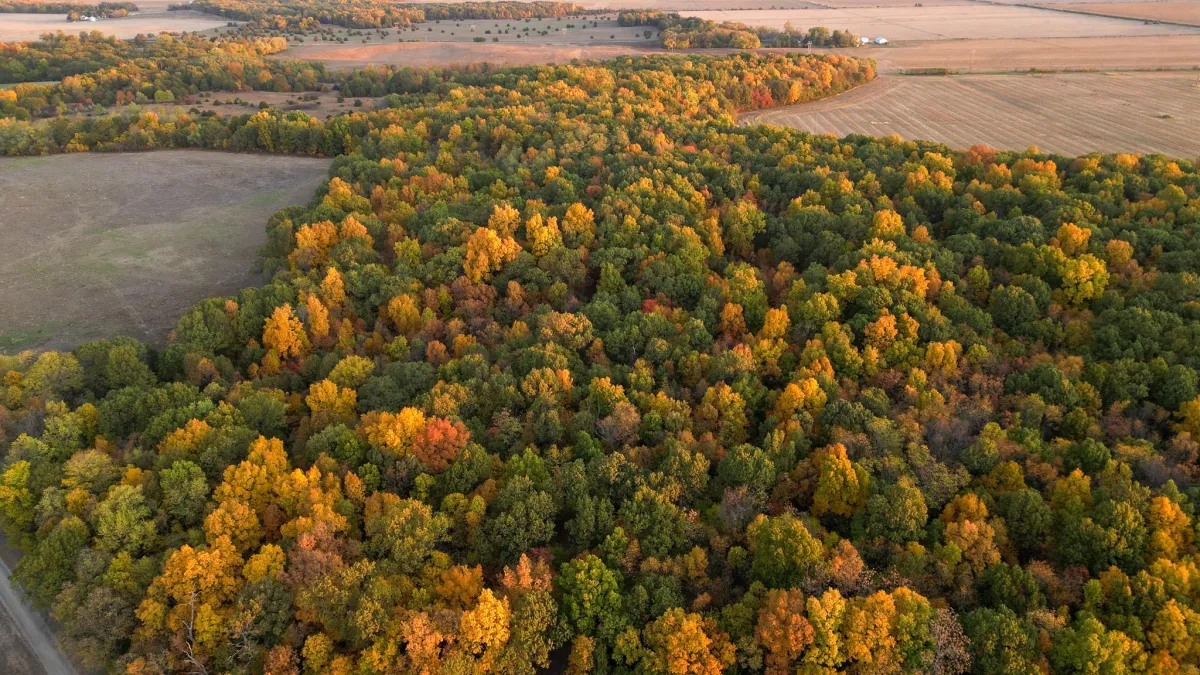
What Illinois Hunting Land Is Actually Worth in 2026 — Beyond the Per-Acre Price
The Number Everyone Asks and the Question Behind It
When a buyer calls about hunting land in Illinois, the first question is almost always price per acre. It is a reasonable starting point and a completely incomplete way to evaluate what a piece of ground is actually worth to the person pursuing it.
In 2026, recreational ground across the western Illinois river counties is trading in a range wide enough to make the per-acre average meaningless. Pike County river-bottom timber with mature oaks, reliable water, and low neighbor pressure is selling at $7,500 to $9,500 per acre. Flatter recreational ground in Mason or Tazewell — serviceable but structurally thin — is trading at $3,000 to $4,200 per acre. Same state. Different planets.
Thirteen years producing for the Outdoor Channel, walking properties from Mississippi River bluffs to central Illinois agricultural corridors, taught me one thing above everything else: the camera does not lie about habitat, and neither does February.
The Western Illinois River Counties — and Why They Command What They Do
Pike, Cass, Brown, and Schuyler counties sit along or near the Illinois River corridor and its tributaries, and they are not interchangeable. Pike County commands the highest recreational premiums in the state for a reason. The terrain is broken — genuine bluff-to-bottom topography with mature timber, limited row-crop pressure in the timber blocks, and a buyer pool that extends well beyond Illinois. Out-of-state demand for Pike County ground has been consistent and is not softening in 2026.
Cass County sits directly south and east of Pike. The river-bottom ground along the Illinois River in Cass is legitimate — comparable habitat structure in many cases — but Cass carries slightly less cachet with the national buyer pool and prices reflect that. Expect $5,000 to $7,500 per acre on quality Cass timber tracts, with variance based heavily on timber maturity and access.
Brown County, tucked west of Cass and south of Pike, offers some of the most underappreciated hunting ground in the state. Timber quality can match Pike in specific drainages, but Brown does not have Pike's reputation and does not carry Pike's price. Buyers who know terrain over brand will find better value in Brown. Current range on quality Brown County timber: $4,500 to $6,500 per acre.
Schuyler County falls south of the Pike-Brown-Cass cluster and transitions toward flatter agricultural-recreational ground as you move east. Schuyler can trade at $3,500 to $5,500 per acre depending on terrain position. Adams County, bordering the Mississippi to the west, has its own dynamics — strong in specific areas, more agricultural-dominant overall.
What Actually Moves the Number
Four variables — more than any others — separate a $4,500 property from an $8,500 property in Illinois.
Timber maturity is the first. Mature oaks with established mast production are not replaceable on a short timeline. A 60-year oak flat is not equivalent to a 20-year regrowth thicket, even if the acreage is identical. When I walk a property and the timber canopy closes overhead in August, that is a different asset than a property with young growth that looks thick in summer and transparent in November.
Edge transitions are the second. Ground that stacks diverse habitat types — mature timber to young regrowth to ag field edge to creek bottom — within a tight geography concentrates deer movement. Properties with a single habitat type require deer to travel for variety. Properties with stacked edges hold deer. The difference shows in trail cameras and in price.
Water sources are the third. Reliable year-round water inside a timber block adds disproportionate value. A creek that runs in October and holds water through November is not the same as a drainage that goes dry by September. I have seen otherwise ordinary properties command 20 to 30 percent premiums solely because of interior water.
Neighbor pressure is the fourth and the one buyers underestimate most. A 120-acre tract surrounded by heavy hunting pressure on all four borders is a transfer property — deer move through, they do not stay. The same 120 acres bordered by unhunted timber on two sides and CRP on a third is a destination property. Neighbor configuration does not show up on a listing sheet, and it is nearly impossible to assess accurately without walking the perimeter in late winter.
The February Test
I will not make an offer on hunting land in Illinois without walking it in late winter — ideally February. The reason is simple: August and September hide everything. Canopy covers bad timber structure. Standing crops obscure sight lines. Shoulder-high vegetation makes a drainage look like a travel corridor when it is actually a dead end.
February strips the property down to its skeleton. With leaves off, you can read the terrain, assess timber quality, see the neighbor's stand locations from your boundary, evaluate whether the water sources hold, and understand what the access routes actually look like in hunting season. Properties that look marginal in summer sometimes reveal extraordinary structure in February. Properties that photograph beautifully in summer sometimes reveal why the deer do not stay.
After 13 years filming properties across the country, the February walk became non-negotiable for me and the buyers I work with. The camera sees truth. So does late winter.
What the Per-Acre Number Cannot Tell You
The per-acre average for Illinois recreational ground in 2026 is somewhere in the $4,500 to $6,000 range depending on whose data you are using and which counties they are pulling from. That number describes a median. It does not describe your 80-acre Cass County river bottom with a spring-fed pond and an unhunted neighbor to the north — and it does not describe the flat Sangamon County recreational tract with a gravel pit on one border and a busy road on another.
Value in recreational real estate is specific. The acre count is just the container. What is inside the container — and what surrounds it — is what you are actually buying.
Jared Williams is the Managing Broker and owner of Archer Realty & Auction LLC. He spent 13 years as a producer for the Outdoor Channel before returning to Illinois to build a land brokerage rooted in operator-level expertise. Start the conversation at archerrealty.net.