Youth Deer Season Is This Weekend: What to Verify Before You Buy Pike County Hunting Ground
The 45-Day Window and What It Demands of a Buyer
Youth firearm deer season opens October 10. First firearm season runs November 20 through 22. A buyer who wants to hunt a new Pike County property during firearm season needs to close before November 20 — which means property under contract within the next two weeks, a 30-day closing, and title work that does not hit a snag. That is a realistic timeline if the buyer is prepared, the property is clear, and neither party delays. It is not realistic if the buyer is still evaluating three properties, has not spoken to a lender, and is expecting to negotiate over several weeks.
The buyers who make this timeline work are the buyers who have done the advance work. They know the county, they know what they want, they have financing either in hand or pre-approved for the price range, and when they walk a property they are confirming a decision rather than starting one. The checklist below is what separates a productive fall showing on Pike County ground from a showing that produces good conversation and no contract.
Bedding and Travel Cover — The Two Variables That Determine Hunt Quality
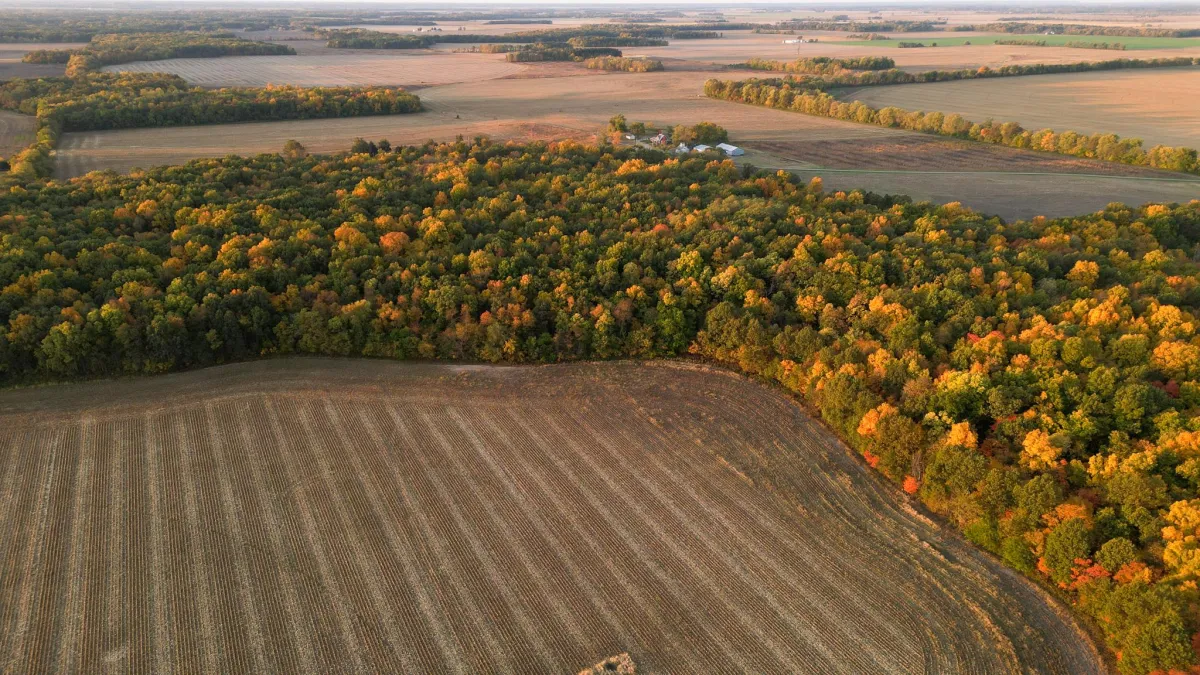
Walk the bedding areas first. In Pike County bluff-country terrain, bedding is in the dense timber on the south-facing slopes and in the creek-bottom draws where wind protection, overhead cover, and proximity to water converge. Identify where deer are bedding on the property by looking for rubs on saplings at the perimeter of the bedding zone, tracks in soft creek-bank soil, and the compressed grass or leaf-litter beds in the thickest timber. A property that cannot show you bedding deer sign in the first hour of a walk is a property that either does not hold deer in the numbers you are expecting or has had enough pressure that the deer have shifted their bedding to a neighbor's ground.
Travel cover connects bedding to food. The stands that produce in November are the stands on the travel corridors — the ridgeline saddles that deer cross when moving from one drainage to the next, the creek crossings that concentrate rut movement, the pinch points where timber narrows between two open areas. Walk those corridors and identify whether the existing stand infrastructure — hang-on stands, ladder stands, tripods — is positioned on actual deer travel or on the locations where a previous hunter thought deer would travel. These are frequently different places. A property with 12 stands, none of them on a documented corridor, will hunt worse than a property with 3 stands on proven travel routes.
Access Easements — What Must Be Confirmed Before Closing, Not After
Pike County bluff-country properties frequently have access situations that are not obvious from a county road. A two-track that has functioned as the primary access for 30 years may cross a neighboring parcel without a recorded easement. The prior owner and the neighbor had a handshake understanding that worked for both of them. When the property sells and a new owner arrives, the neighbor has no legal obligation to honor that understanding. The new owner who assumed access was established now has a property they cannot access without the neighbor's permission.
Request a title commitment before closing and have your attorney identify every parcel the access road crosses between the county road and the hunting property. Each crossing must have a recorded easement in the chain of title that grants your right of access. If it does not, that is a negotiating point before closing — either the seller resolves the easement or the price reflects the access uncertainty. Do not assume that because the prior owner could reach the property without issue, you will be able to do the same.
Also confirm road condition in November and December. A gravel farm road that is fine in October can become impassable after three inches of rain in November. A property that is only accessible during dry conditions is only huntable during dry conditions, which does not include most of firearm season in a typical Pike County year.
CRP Contract Terms — What You Are Inheriting When You Buy
A significant number of Pike County recreational properties have CRP acres enrolled in USDA contracts. Those contracts carry obligations that transfer with the land. A buyer who closes on a property with active CRP enrollment is inheriting the contract terms — the restrictions on land use during the contract period, the requirement to maintain the enrolled cover according to the practice standards, and the penalty structure for violating the contract terms. Plowing up a CRP stand to establish a food plot is a contract violation that can trigger repayment of the annual payments received plus a penalty. Mowing enrolled grass at the wrong time of year for the same reason.
Request the CRP contract documentation before closing. Identify when the contract expires, what the annual payment is, what the land use restrictions require, and whether any practices on the property have been out of compliance. A CRP contract with three years remaining at $85 per acre per year on 40 acres is a $10,200 income stream the buyer is acquiring — and also a set of obligations they are inheriting. Understand both before the closing table.
Neighbor Pressure — The Invisible Variable in Every Pike County Hunt
Pike County's reputation for large deer is real, and it produces hunting pressure on almost every property in the county at some level. The question for a specific property is what the pressure profile of the neighboring parcels looks like — how many hunters are on the adjacent ground, what access they have, and whether their hunting practices tend to push deer toward your ground or off it during daylight hours. A property surrounded by heavily pressured neighbors may see the deer you are managing move to your ground during the rut, which is a benefit. The same property may see those deer educated and nocturnal by November 15 because the neighbors have been running too many hunters through the timber since October 1.
Walk the fence lines and look for stand sign on the neighboring parcels from the property boundary. Ask the seller or their neighbors directly. Attend the county's sporting goods and feed stores the week before showing — the conversations there tell you more about the pressure profile of a specific township than any satellite map will. A buyer who understands the neighborhood before making an offer is not surprised by what they find during firearm season.
What Can Realistically Be Hunted This Season If You Close in Time
A buyer who closes on a Pike County property by November 10 can hunt firearm season on their own ground on November 20. What they cannot do is have the property fully prepared — food plots planted and producing, permanent stand infrastructure installed in the right locations, mineral sites established and frequented by deer that have accepted human presence in that location. The first firearm season on a new property is a scouting season with a weapon in hand. The information a hunter gathers during their first firearm season on a new property — where the deer are moving, which corridors are active, where the sign concentrates — is the foundation for the second season and every season after. A buyer who understands this will not be disappointed. A buyer who expects to close in October and immediately sit on a 180-inch deer will be.
Jared Williams is the Managing Broker and owner of Archer Realty & Auction LLC. He spent 13 years as a producer for the Outdoor Channel before returning to Illinois to build a land brokerage rooted in operator-level expertise in recreational real estate across central and western Illinois. Start the conversation at archerrealty.net.