The February Test — Why I Walk Every Hunting Property in Late Winter Before Buying
What August Hides and February Reveals
Hunting land photographs beautifully in August. The canopy is full. The underbrush is thick. Every drainage looks like a travel corridor. Every thicket looks like a bedding area. The property looks productive because it looks productive — until the leaves come off in late October and you realize that what looked like edge cover was actually a single-species brush stand that deer browse through without stopping, and what looked like a timber interior was actually a uniform canopy with no structural variety that holds deer through mid-November.
I walked my first Illinois hunting property for the Outdoor Channel in late October. I had walked many before and many after, and over 13 years of producing content on properties across the Midwest, I developed a principle that I now apply to every piece of recreational ground I evaluate for a buyer: no opinion is formed, no offer is encouraged, until the ground has been walked in late winter.
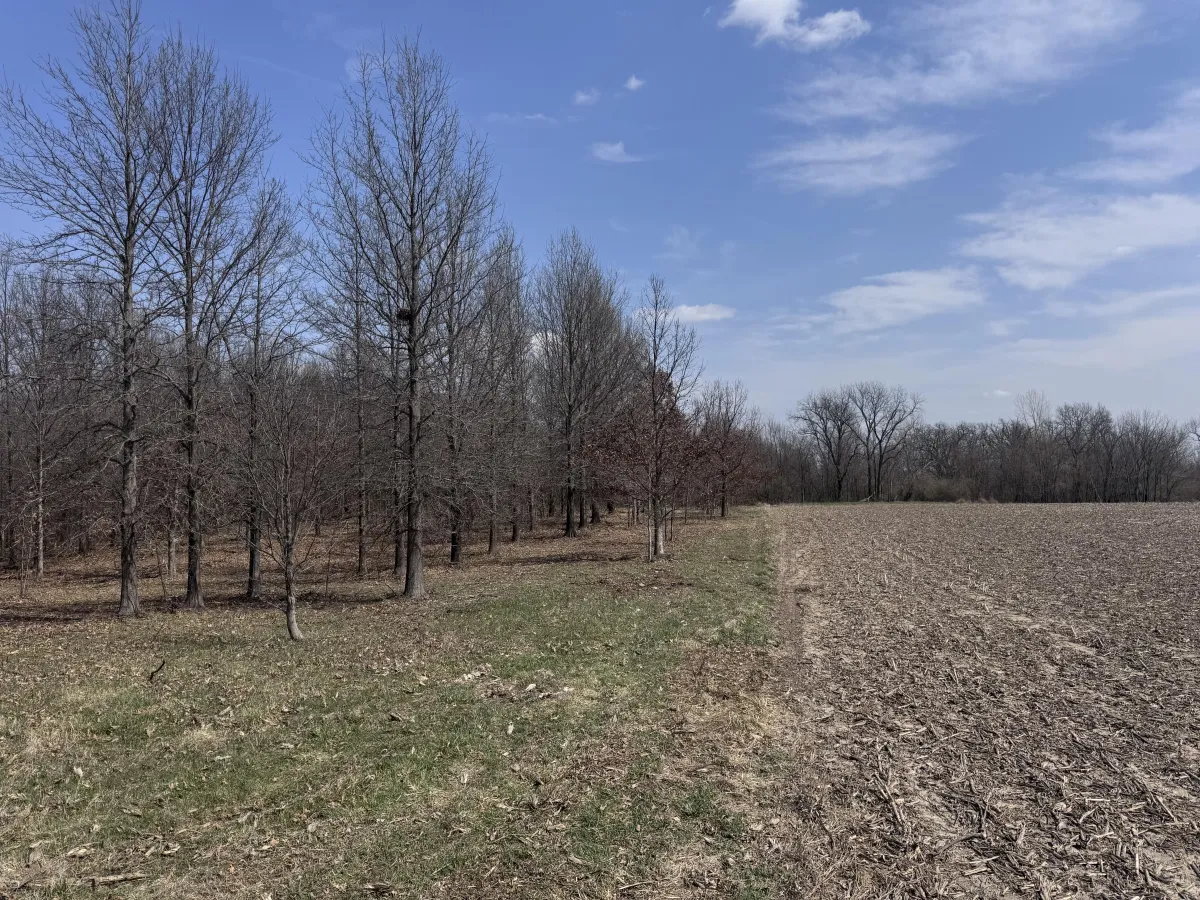
February is the month. The leaves are off. The snow, if it has been recent, shows exactly where animals have been moving. The ground is firm enough to walk without destroying it. And every structure feature the property has — or lacks — is fully visible.
Timber Structure — What You Cannot Evaluate With Leaves On
The first thing February reveals about a timber property is its actual structure. With a full canopy, a mature oak stand and a 15-year regrowth thicket look dramatically different in photographs but surprisingly similar on the ground — both appear as thick, green, impenetrable cover. Without leaves, the difference is unmistakable.
Mature oaks have a canopy structure that creates layered habitat — the ground level, the shrub layer, the midstory, and the canopy — and that structural diversity is what holds deer through the season, not just during the rut. A regrowth thicket may offer excellent early-season bedding cover but collapses as a destination habitat when the rut disperses deer and draws them toward established mast producers and doe bedding areas.
In February you can walk through the timber and assess canopy composition — species mix, age class, mast-producing capacity, storm damage — honestly and accurately. You can identify whether the timber transitions naturally into younger regeneration, which creates the edge cover that concentrates deer, or whether it is a uniform stand with no habitat variety. You can see whether there is any understory cover that would provide bedding structure during hunting season. All of this is hidden under full canopy in August and visible in February.
Edge Transitions — Where Deer Spend Their Time
Habitat edges — the transitional zones between different cover types — are where deer spend the majority of their daylight hours during hunting season. A property with diverse, well-stacked edge transitions holds deer. A property that is a monoculture of any single habitat type — even mature timber — does not hold deer as consistently because they have to travel to access diverse resources.
In February, edge transitions are physically visible in a way they are not in summer. You can stand at the timber edge and clearly see the structure of the adjacent cover — whether the field edge offers standing crop residue, whether the neighboring property has CRP or regrowth that provides bedding adjacent to your boundary, whether there is a clear transition from your timber into brushy draws and back into open ground that creates natural funnels for deer movement. In summer, that edge transition is a visual wall of green vegetation with no readable structure. In February it is a map of where the deer will and will not be in October.
Access Routes — What They Actually Look Like in Hunting Season
Access to stand locations is one of the most underestimated variables in hunting property evaluation. A property with excellent habitat but poor access — where every approach to the best stand locations requires crossing bedding areas or walking into the wind against predictable deer movement — is a property that will frustrate a hunter regardless of the deer population it carries.
Evaluating access in August is nearly impossible. Shoulder-high vegetation makes every trail look like a defined route. The actual topography of the approach — whether it climbs a ridge that would be visible to deer in the adjacent timber, whether it crosses a drainage that produces thermals that push your scent into bedding areas, whether it parallels a fence line that channels deer movement across your path — cannot be assessed when the ground is covered in corn or waist-high browse vegetation.
In February, you walk the access routes the way you would walk them in October. You can see every sight line. You can feel the topography in your legs. You can identify where the approach works and where it does not, and whether the stand locations that make the property attractive can actually be accessed without destroying the hunt before it starts.
Water Sources — Reliability When It Matters
Illinois hunting land marketing often references water as a habitat feature: creek frontage, pond, natural water source. The relevant question is not whether water exists on the property in August — it is whether reliable water exists in October and November, when deer are seeking it and hunters are hunting it.
A February walk gives you the honest version of the water picture. A creek that holds water in late winter is a creek that holds water in October. A pond that is full in February with healthy banks is likely a functional year-round water source. A drainage that is bone-dry in February after a winter with average precipitation is a drainage that is likely marginal or seasonal — not the reliable interior water source that adds premium value to a property.
I have walked properties in February where the sellers described a year-round creek that turned out to be a dry drainage with a wet-weather channel — functional for a brief period after significant rain and empty the rest of the hunting season. That information was not available on the summer walkthrough, and it would not have been available on the purchase photo packet. February told the truth.
Neighbor Visibility — The Variable That Does Not Show Up on the Listing Sheet
The single most predictive variable of long-term hunting quality on a property is the neighbor configuration — specifically, what the neighbors are doing and whether their activity pressure is likely to interfere with the deer behavior on the subject property. A 120-acre tract surrounded by actively hunted neighbors is a fundamentally different hunting asset than the same 120 acres with unhunted timber on two sides and CRP on a third.
In February, with leaves off, you can walk your prospective boundary lines and see what is on the other side. You can identify whether the adjacent property has stand locations visible from your ground — which tells you the deer know exactly where the pressure comes from and when. You can see whether the neighbor has permanent infrastructure — box blinds, elevated stands, food plots — that suggests consistent, organized hunting pressure. You can assess whether the adjacent cover is the kind that holds deer independently, which acts as a sanctuary that spills deer onto your property, or the kind that functions as a hunting property itself, which competes directly with yours.
This evaluation is not available in summer. The same boundary walk in August reveals vegetation but not visibility, cover but not context. February shows you everything.
The Principle Behind the Practice
The February test is not a ritual. It is a commitment to seeing a piece of ground as it actually is rather than as it presents at its most photogenic. After 13 years of walking properties for the camera and another several years walking them for buyers, I have seen the same mistake made repeatedly: a buyer falls in love with August photographs, walks the property in September, and closes on a parcel they only truly understand on the first November hunt — when the leaves come off and the property they thought they bought reveals what it actually is.
The solution is simple: walk the property in late winter before making an offer. What you see in February is what you are buying.
Jared Williams is the Managing Broker and owner of Archer Realty & Auction LLC. He spent 13 years producing hunting content for the Outdoor Channel before returning to Illinois to build a land brokerage grounded in the kind of habitat knowledge that comes from walking ground professionally rather than looking at it from a distance. Start the conversation at archerrealty.net.