Why Central Illinois Farmland Is Trading at $15,000–$20,000 Per Acre in 2026 — And What It Means for Your Ground
The Numbers Are Real — and They Are Not Distributed Evenly
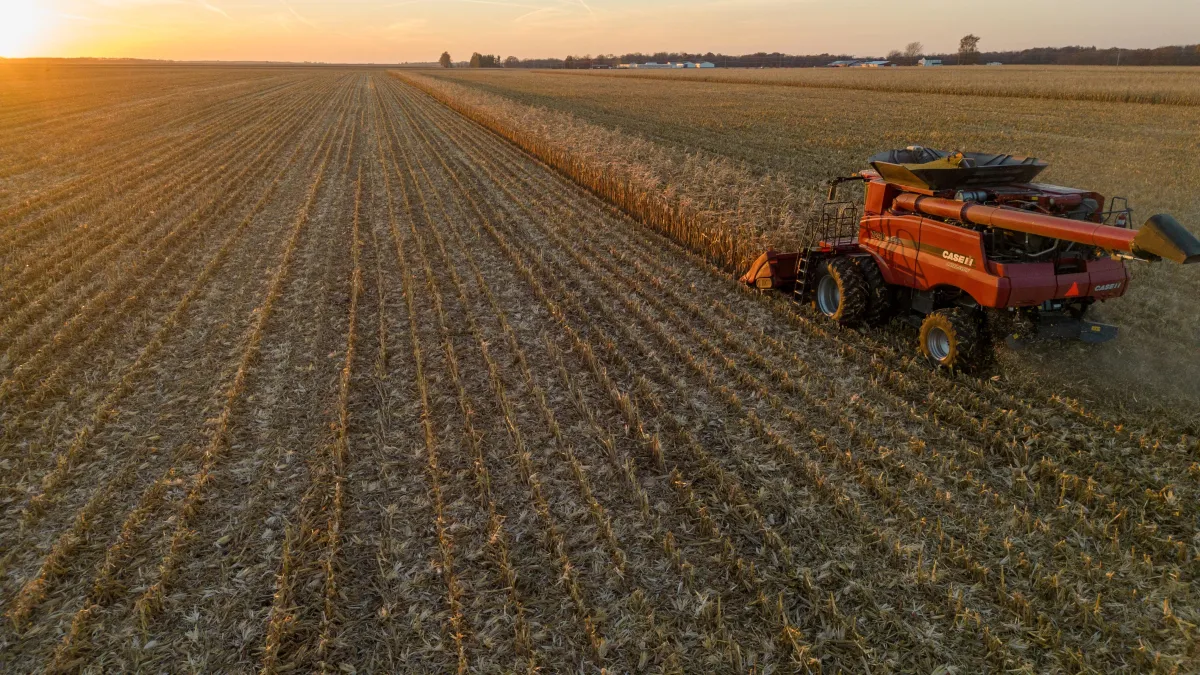
Central Illinois farmland is trading at levels that would have seemed aggressive five years ago. In 2026, top-tier ground in McLean, Livingston, Piatt, and Macon counties is clearing $15,000 to $20,000 per acre at auction and private sale. These are not outlier sales on exceptional parcels. They represent what the market is paying for productive ground with strong soil scores, established drainage, and competitive buyer pools.
The story becomes more complicated — and more useful — when you start mapping what that pricing looks like county by county, and then understand the one number underneath all of it: the Productivity Index.
The Top-Tier Counties and What They Are Doing
McLean County consistently leads central Illinois in per-acre values. The combination of extremely high average PI, large productive tracts, and deep farmer and investor demand keeps McLean ground at the upper end of the state range. Strong McLean County tracts with PI scores above 135 are trading at $17,000 to $20,000 per acre in 2026, with multiple registered bidders at auction on most offerings.
Livingston County sits north of McLean and carries similar soil productivity in its best sections. Livingston has benefited from strong commodity-driven farmer demand — owner-operators buying adjacent ground — and sees similar pricing dynamics to McLean on comparable soil scores.
Piatt County, southwest of Champaign, is one of the most productive farming counties in Illinois on a per-acre basis and the market knows it. Piatt ground with PI above 130 is trading in the $15,000 to $18,500 range with strong competition. The county has a concentrated farmer base that competes hard for land close to their existing operations.
Macon County, home to Decatur and anchored by some of the deepest dark soil profiles in the state, is trading at $14,000 to $17,500 for top-tier ground. Macon benefits from proximity to major grain handling infrastructure, which keeps local farmer demand high.
The Mid-Tier: Sangamon, Menard, and Cass
Move west toward the Illinois River and the numbers shift. Sangamon County — which includes Springfield — carries excellent ground in its eastern half where soils flatten and PI scores climb, but the county average is pulled down by more varied terrain in the west. Top Sangamon County ground is trading at $12,000 to $15,000 per acre. Average to below-average Sangamon ground is $8,500 to $11,500.
Menard County, where I serve on the Board of Review, is a terrain-driven market. The Illinois River bluffs along the western edge and the creek drainage systems through the middle create a county where PI variance is high and per-acre values follow that variance tightly. Top Menard County cropland with PI above 120 is trading at $10,000 to $13,500. Timber and recreational ground brings its own separate pricing dynamic.
Cass County, west of Menard along the Illinois River corridor, has the same terrain complexity as Menard with additional recreational demand competing for some of the same parcels. Productive Cass County cropland in the flat eastern sections is trading at $9,000 to $12,500 per acre. River-bottom ground can command recreational premiums that exceed the agricultural value entirely on the right tract.
The Productivity Index — What It Is and Why It Is the Lever
The Productivity Index is Illinois's soil rating system, developed by the University of Illinois to score soil types on their capacity to produce corn under average management. The scale runs from the low 50s on poor, heavy clay soils to 147 on the state's finest deep black loam profiles. The number is assigned by soil type — not by how a particular farmer farms the ground — and it is the single most consistent predictor of per-acre value in the Illinois farmland market.
At current market levels, the math on PI points is approximately $100 to $150 per PI point per acre. That means the difference between a farm averaging PI 119 and one averaging PI 132 — 13 points — translates to roughly $1,300 to $1,950 per acre in market value. On a 160-acre farm, that gap is $208,000 to $312,000. On a 320-acre farm, it approaches $600,000. PI is not a minor adjustment. It is the core driver of value.
The practical implication for landowners: know your farm's average PI before you have any conversation about value or listing strategy. The USDA Web Soil Survey at websoilsurvey.sc.egov.usda.gov allows you to pull soil data and cross-reference Illinois PI scores by soil type. It is not a substitute for a professional evaluation, but it gives you an honest starting point.
The Board of Review Angle
One area where PI matters beyond sale value is property tax assessment. In Illinois, agricultural land is assessed based on its agricultural economic value — a formula that factors in soil productivity. If your farm is incorrectly classified or if the soil mapping on your parcel contains errors, your assessed value may not reflect the actual productivity of your ground.
The Board of Review process exists as the mechanism to challenge those assessments. In Menard County, I see complaints every year where the underlying issue is a soil classification that does not match the actual soil profile on the ground. A field that is mapped as one soil type but consistently performs like another may have a legitimate case. The process requires documentation — yield data, soil tests, and sometimes independent soil sampling — but it is a legitimate avenue for landowners who believe their assessment does not reflect ground truth.
What This Means If You Are Considering a Sale
The 2026 market is strong for top-tier ground. It is more selective for average to below-average ground. The gap between what premium PI farmland commands and what marginal farmland brings has widened in the last 18 months as institutional investors have become more selective and farmer-driven demand has concentrated around productive, well-drained tracts close to existing operations.
If you are considering whether to sell, the first step is an honest assessment of where your ground sits in the PI distribution for your county — not your county's average, but your specific field-level scores. That tells you whether the market is working in your favor or whether timing and positioning require more thought.
Jared Williams is the Managing Broker and owner of Archer Realty & Auction LLC. He serves on the Menard County Board of Review and specializes in agricultural land sales and auction services across central Illinois. Start the conversation at archerrealty.net.